Internet of Things Bootcamp
IoT and Microcontroller Bootcamp, ESP32 with Arduino C++ and MicroPython .
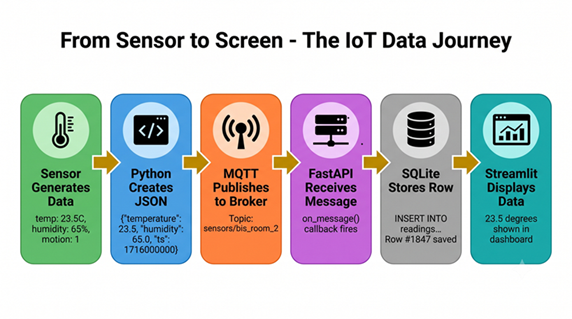
Designed for further education students and mid‑career engineers, this bootcamp develops practical IoT engineering skills from the ground up. Working through six structured weeks, students progress from IoT fundamentals and ESP32 hardware architecture through Arduino C++ and MicroPython programming, sensor and actuator integration, Wi‑Fi and MQTT communication, cloud architecture, and IoT security.
Each week culminates in a 10‑question assessed quiz to reinforce learning. Practical sessions use the Wokwi online simulator — removing hardware cost barriers while maintaining hands‑on, circuit‑level learning. No expensive equipment needed; everything runs in your browser.
🌟 Black Pioneer Integration
The course features contributions from Black scientists and engineers who shaped the technology landscape, integrating representation and cultural relevance throughout — ensuring diverse learners see themselves in STEM.
By the end of this six‑week journey, you'll have the skills to design real IoT systems, understand hardware constraints, write embedded code, and make architectural decisions for production deployments. Whether you're a student exploring further education in engineering or a mid‑career professional transitioning into IoT, this bootcamp provides the foundation you need.
Learning Objectives
- Explain IoT system architecture and identify appropriate protocols and hardware for real-world applications
- Describe the ESP32 microcontroller's hardware capabilities including GPIO, ADC, PWM, and power modes
- Write functional Arduino C++ sketches for digital and analogue I/O, PWM, and Serial communication
- Write MicroPython scripts using the machine module for GPIO, ADC, I2C, and interrupt-driven input
- Integrate common IoT sensors (DHT22, capacitive soil moisture) and actuators (OLED, relay) in simulated circuits
- Establish Wi-Fi connectivity and implement the MQTT publish/subscribe protocol with structured JSON payloads
- Describe edge, fog, and cloud processing layers and select appropriate processing locations for given requirements
- Apply IoT security principles including the OWASP IoT Top 10, TLS encryption, and device authentication
- Design a complete end-to-end IoT system architecture incorporating reliability patterns and documentation
- Identify career pathways in IoT engineering including TinyML, IIoT, and IoT security specialisms
Prerequisites
- Basic computer literacy (ability to use a web browser and text editor)
- Basic mathematics (algebra and units of measurement)
- No prior programming or electronics experience required
Course Content
Week 1: Introduction to IoT and the 4th Industrial Revolution
What is the Internet of Things?
IoT Applications and Real-World Challenges
Build Guide: Your First Wokwi Simulation (Video Walkthrough)
Week 1 Assessment: IoT Fundamentals
Week 2: ESP32 Hardware and Arduino C++ Programming
The ESP32: Architecture and Hardware Fundamentals
Arduino C++ Programming for IoT
Build Guide: GPIO Control and Analogue Reading in Wokwi
Week 2 Assessment: ESP32 Hardware and Arduino C++
Week 3: MicroPython and Sensor Integration
MicroPython for the ESP32
Building Sensor Systems with MicroPython
Build Guide: Mini Weather Station in Wokwi
Week 3 Assessment: MicroPython and Sensor Systems
Week 4: Wi-Fi Connectivity and MQTT
Connecting to the Internet: Wi-Fi and MQTT
Capstone Project Preparation: Building a Plant Watering System
Build Guide: Publish Sensor Data to an MQTT Broker (Video Walkthrough)
Week 4 Assessment: Wi-Fi, MQTT, and Actuator Control
Week 5: Cloud Architecture and IoT Security
Edge Computing, Cloud Integration, and IoT Architectures
IoT Security: Principles, Threats, and Practical Defences
Build Guide: Node-RED Dashboard for Your Plant Monitor (Video Walkthrough)
Week 5 Assessment: Cloud Architecture, Security, and Data Pipelines
Week 6: Capstone Project and Future Pathways
End-to-End IoT System Design
Future Pathways: TinyML, IIoT, and Professional Practice
Build Guide: Complete End-to-End IoT System (Capstone Blueprint)
Week 6 Final Assessment: End-to-End IoT Systems
Health Checker
Content Protection Notice
Content Protection Notice
Premium Content Preview
This course includes:
- 6 interactive quizzes
- 26 comprehensive lessons
- Multiple lesson formats (videos, readings, activities)
- Progress tracking and certificates
Enroll now to access all content!
Course Information
The Scientists Behind This Challenge
Need Help with This Course?
Have a question about Internet of Things Bootcamp? Message Black Scientists and Inventors Platform directly and we'll get back to you.


